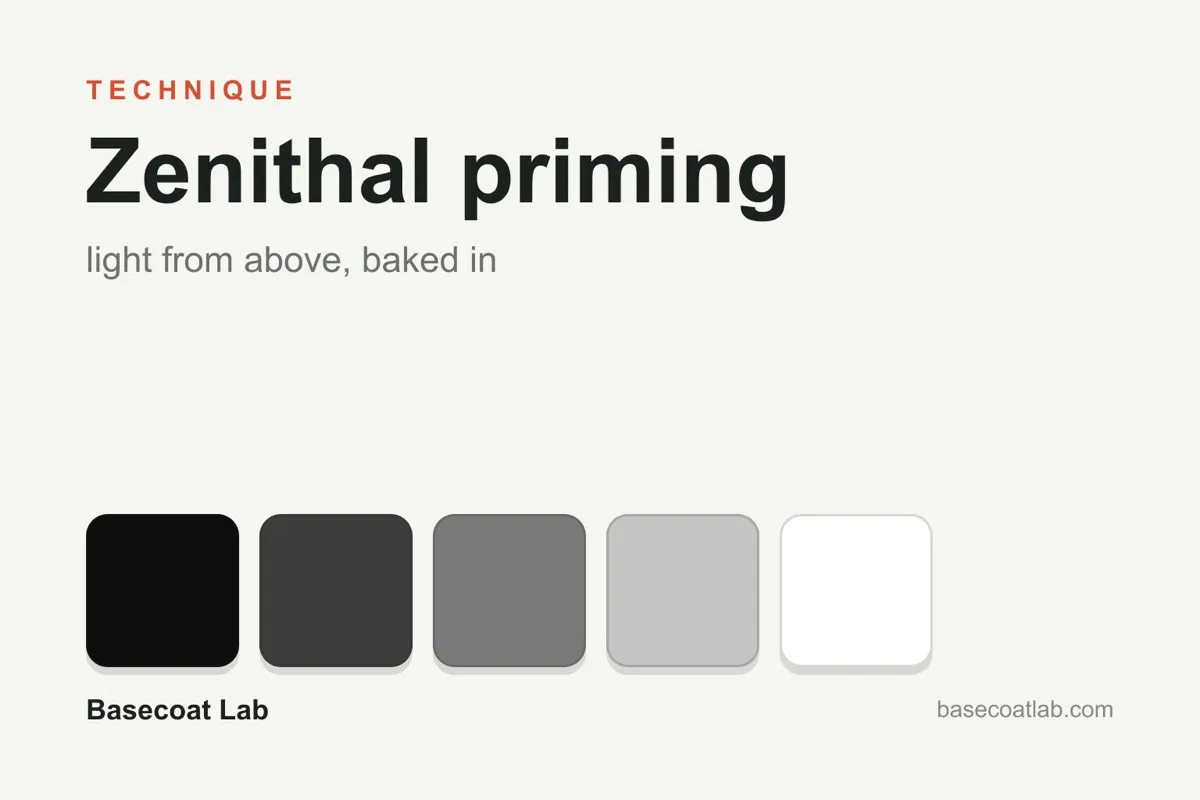
Zenithal priming is priming a model as if the sun were directly overhead: black everywhere, grey from 45 degrees, white from the top. The result is a monochrome model with all its lighting already decided — before a drop of color goes on. The name comes from "zenith," the point straight above.
The three-spray version
- Black primer over everything, from every angle. This is the only coat that has to be a true primer; the layers above it are just paint.
- Grey from roughly 45 degrees, rotating the model so every side catches some.
- White from directly above, a light dusting that only lands on upward faces — helmets, shoulders, the tops of folds.
Aerosol cans do this fine; an airbrush does it with more control and less risk of the grainy texture cans leave in cold or humid weather. There is also a no-spray version: the grey and white steps done with a drybrush instead, which is exactly the slapchop method.
What it is actually for
As a guide: even if you paint opaquely over it, the zenithal shows you where highlights and shadows belong — it is a sketch of the finished lighting that saves every "where does the highlight go?" decision later.
As an underpainting: translucent paint over a zenithal keeps the light map visible. One-coat paints (Contrast, Speedpaint, Xpress Color) were practically made for this — the Contrast paint chart lists every color, and thinned regular acrylics used as glazes work the same way.
For airbrushed color: a zenithal under a translucent airbrushed color coat gives instant volumetric lighting on vehicles and monsters.
When it is not worth the cans
If you plan to base-coat everything opaquely in bright saturated colors, the zenithal disappears under the first coat and you have spent two extra sprays for nothing — a plain grey or colored primer serves better. The same goes for schemes built on white: prime white and glaze shadows instead.
The mistakes that ruin it
Spraying the white from too close or too low (it floods the midtones and kills the gradient), skipping rotation on the grey pass (one side ends up unlit), and heavy-handed color over the top (opaque paint erases the work). Keep the white to a dusting and the paint over it thin, and the zenithal does the shading for the rest of the project.
For which primers behave well as the black base coat — and when a brush-on primer beats any can — see the primer guide.