Drybrushing is the technique that makes texture pop with almost no skill investment: a nearly-empty brush dragged flat across a model catches every raised edge and leaves the recesses untouched. It is how chainmail, fur, rock, and rubble get painted quickly, and it is the engine behind the slapchop method taking over speed painting.
What you need
An old or cheap brush with some spring left — drybrushing destroys brushes, so never use your detail brush. A soft makeup brush is the community's favorite upgrade for large areas because it leaves fewer scratch marks. Any matte acrylic works; lighter than the base coat by two or three steps is the rule.
The technique in four steps
- Load the brush, then unload it. Work a little paint into the bristles, then wipe it back on a paper towel until a stroke across your thumb leaves almost nothing. "Too dry" is nearly always closer to right than "too wet."
- Stroke flat, not with the tip. Hold the brush so the side of the bristles skims the surface, and flick across the texture — across chainmail links, across fur direction, across stone.
- Build in passes. The first pass will look faint. Repeat until the raised detail reads clearly. Two light passes always beat one heavy one, because a heavy pass is how you get chalky smears in the recesses.
- Stop before the flat panels. Drybrushing is for texture. Smooth armor plates and cloth folds show every bristle scratch, so switch to layering or glazing there.
Choosing the highlight color
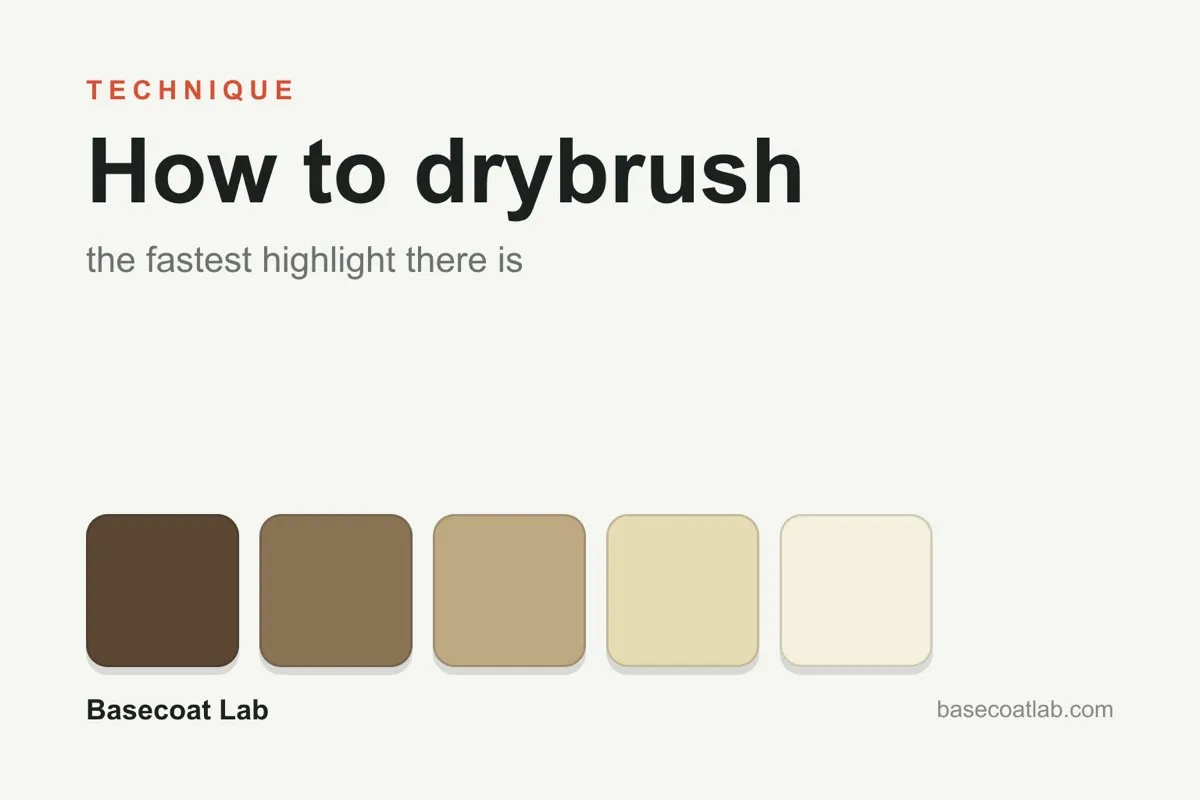
Do not jump straight to white — it turns everything pastel. Lighten the base color instead: a warm brown drybrushed with bone, a dark steel with silver, a deep green with a yellowed green. If you are unsure what two colors sit near each other, the paint mixing calculator will show you what your base color plus a lighter paint actually produces, and every color's own page on this site lists its lighter neighbors by measured distance.
Where drybrushing earns its keep
Bases and terrain (the single best use), chainmail and metallics, fur and feathers, skeletons and bone, rocky cloaks and rubble. Whole armies of skeletons have been painted with a brown base, a bone drybrush, and a wash — that recipe still works.
Where it lets you down
Smooth curved surfaces show scratchy streaks, and over-drybrushing flattens a model into a dusty ghost. If a surface is smooth, glaze or layer it; if you have gone chalky, a thinned wash of the base color pulls it back.
Drybrushing is also step two of the slapchop method — a grey and white drybrush over black primer creates the value map that one-coat paints turn into finished color.