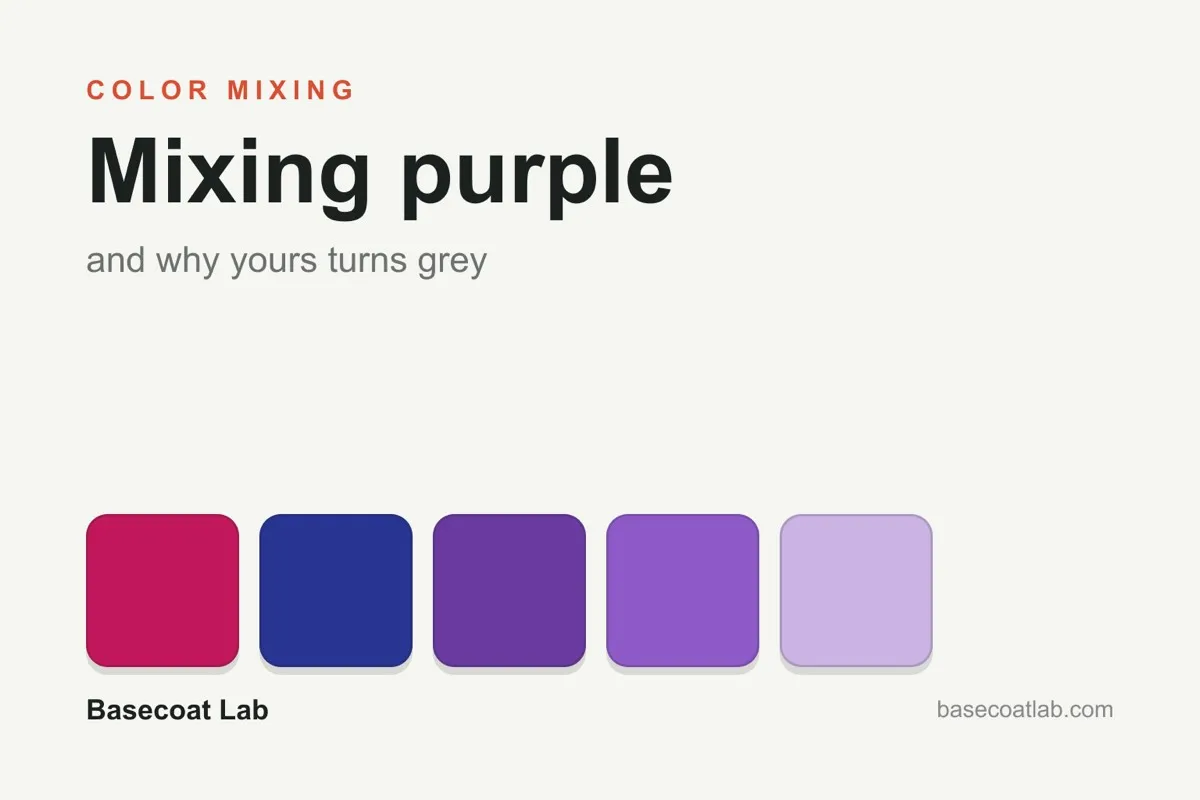
Every child learns that red plus blue equals purple, but every painter learns the hard way that it usually just makes grey-brown sludge. The theory is fine, but the pigments are usually the problem. Getting a clean purple is entirely about choosing the right red and the right blue.
Why your purple turns grey
Most reds lean orange, like a cadmium-type fire-engine red, and many blues lean green, like cyan-types. Orange and green are both purple's enemies because they sit across the color wheel from it. Any orange or green bias in your starting paints will mute the mix. A fire-engine red plus a green-leaning blue contains all three primaries at once, and three primaries make brown, as covered in what colors make brown paint.
The pairs that actually work
Magenta + blue is the clean route. A pink-leaning red, magenta, fuchsia, or rose, carries no orange. This means it mixes vivid purples with almost any blue. It is the closest thing to a cheat code for color mixing.
Crimson + ultramarine-type blue is the classic painter's pair. This uses a cool, blue-leaning red paired with a warm, red-leaning blue. This combination gives you rich royal purples and plums instead of a neon violet.
Avoid warm scarlet reds and green-leaning blues when trying to make purple. At best, they will only make a muted mauve, which might be fine if you are specifically trying to paint a moody cloak.
Steering the result
- Toward violet/blue-purple: Use more blue, or start with ultramarine.
- Toward plum/red-purple: Use more of the cool red.
- Lavender/lilac: Add white. Purple takes white gracefully, unlike brown.
- Deep royal shadow: Add a touch more blue rather than black. Black can turn purple into charcoal very quickly.
- Muted, greyed purple on purpose: Add a whisper of yellow. As its complement, a tiny bit of yellow knocks the saturation down evenly.
Check the mix before you commit
Whether your specific red and blue produce the purple you want depends on their pigments and proportions, not their names. The paint mixing calculator previews a digital blend of approximate catalog swatches; it does not predict the physical pigment mixture, so you should test a small amount on the palette first. Since most major brands sell ready-made purples, it is also worth checking if the shade you want already exists. Catalog purples across twelve brands are swatched in the charts, starting from the Vallejo color chart and the Citadel paint chart.